
What it does
product-mode is a drop-in CLAUDE.md / AGENTS.md for Claude Code,
Cursor, Codex, and any coding agent that reads one. It targets the mistake that costs product
teams most: shipping the wrong thing, well.
Karpathy's guidelines fix how agents write code. product-mode adds the missing layer: problem framing, scope discipline, tradeoffs, outcome measurement, and decision logging, applied before the code gets written.
| # | Principle | What it prevents |
|---|---|---|
| 1 | Frame the Problem Before the Solution | Building for the wrong user |
| 2 | Make Assumptions & Unknowns Visible | Silent guessing |
| 3 | Ship the Minimum Viable Change | Scope creep, gold-plating |
| 4 | Name the Tradeoffs | Invisible costs, political decisions |
| 5 | Define Done by Outcome, Not Output | "Merged" mistaken for "done" |
| 6 | Instrument Before You Ship | Shipping blind |
| 7 | Log the Decision, Flag Reversibility | Repeating mistakes, calcifying defaults |
Before any non-trivial change, the agent fills a five-box pre-flight checklist: Problem, Why now, Scope, Primary metric, and Reversibility. If a box is empty, it fills it or says out loud that it is going ahead without it.
The full rules live in one file: CLAUDE.md on GitHub.
When to reach for it
Not every change needs all seven principles. The file opens with this table, so the agent scales the rigor to the change:
| Change type | Apply |
|---|---|
| Typo, comment, obvious one-liner | None. Just do it. |
| Bug fix, small internal refactor | Principles 2, 3, 5 |
| New user-facing feature | All seven |
| Architecture, pricing, public API, data model | All seven + explicit one-way-door sign-off |
The goal is fewer costly mistakes on non-trivial work, not ceremony on trivial work.
What it looks like
Three worked examples. They are authored teaching scenarios, not model transcripts or measured results.
Add a dashboard
- Request
- "Add a dashboard to our SaaS app with charts, filters, and export."
- Asks first
- Which user needs this, and what decision will they make after looking at it?
- Smallest scope
- A list of overdue jobs, sorted by age, linking to the existing job detail page.
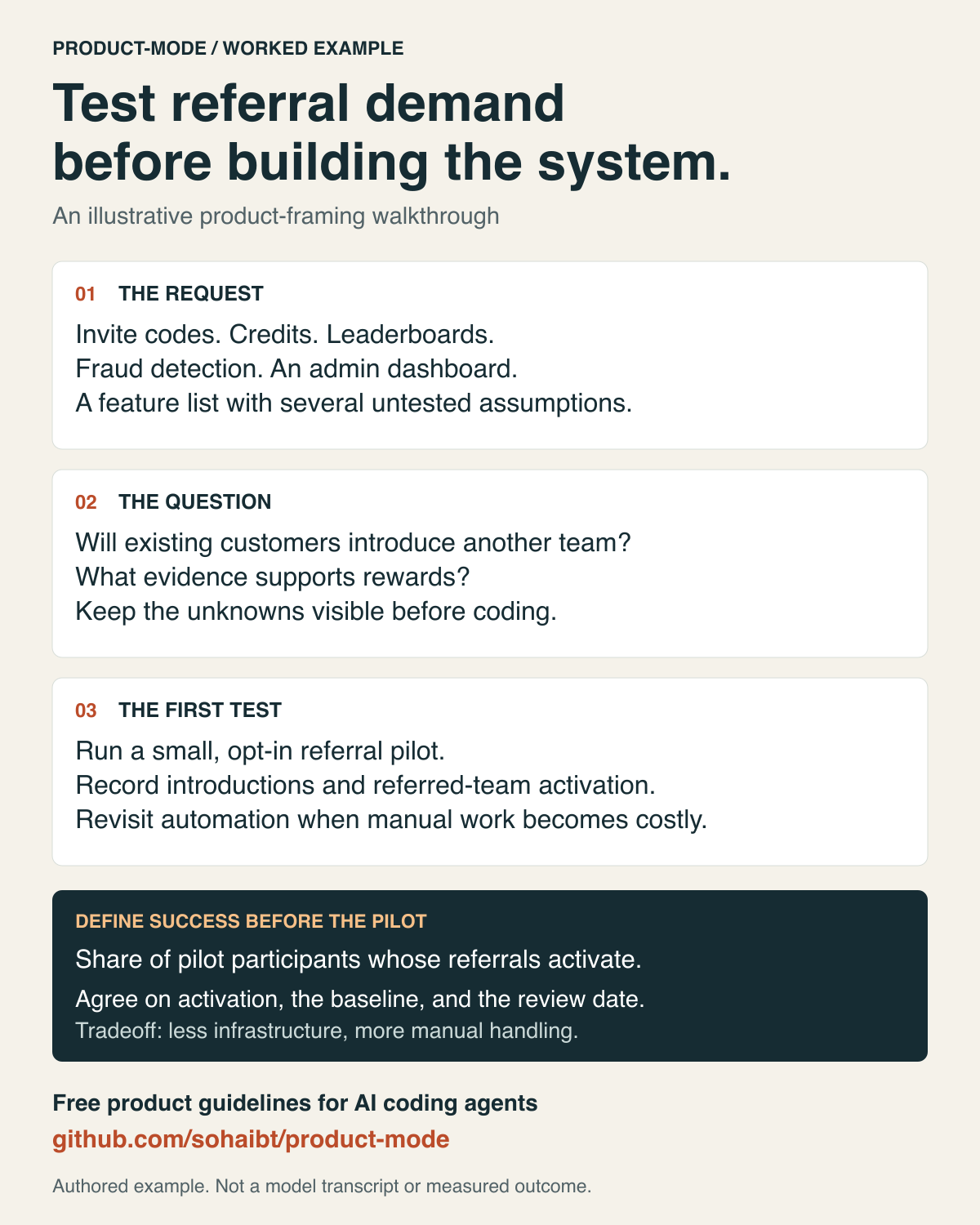
Build a complete referral system
- Request
- "Build referrals with invite codes, credits, leaderboards, fraud detection, and an admin dashboard."
- Asks first
- What evidence says customers want to refer others, and what is the smallest pilot that would test it?
- Smallest scope
- A small, opt-in referral pilot with a simple way to record introductions. No rewards engine yet.
Add an onboarding checklist
- Request
- "Add an onboarding checklist so more users activate."
- Asks first
- What observable action means the user received value, and how often does it happen today?
- Smallest scope
- Guide users to one existing action that represents first value, with a way to resume it later.
It's working if
- Fewer rebuilds because "we shipped the wrong thing."
- Assumptions get challenged before code, not in review.
- Tradeoffs appear in writing, not just in Slack threads.
- Every shipped feature has a metric attached, checked on a date.
- The decision log is the first thing new teammates read, and it's useful.
Common questions
- Do I need to install anything?
- No. The instructions are a text file your agent reads. The CLI is optional. It saves checklists and decision logs, and needs Node.js 20.19 or newer.
- I already have a CLAUDE.md. Will this overwrite it?
- No. The install command refuses to overwrite an existing file. Copy the guidelines you need into your file and resolve any conflicts. The merge guide walks through it.
- Which agents does it work with?
- Claude Code, Cursor, Codex, and any coding agent that reads
CLAUDE.mdorAGENTS.md. Both files have the same content. - Will it slow down small changes?
- It should not. Typos and one-liners skip the rigor. The optional
product-mode trivialcommand checks your changes and tells you if the full checklist applies. - Are the examples real results?
- No. They are authored scenarios. To test it on your own work, send the same request in fresh sessions with and without the guidelines. Here is the comparison protocol.
- Is it free?
- Yes. MIT license. Fork it, adapt it, make it your team's own.
Where it fits
product-mode is the thinking layer. It decides what is worth building. These open-source tools are the doing layers:
- strategy-mcp
- MCP server that gives Claude 12 product strategy frameworks as tools (RICE, JTBD, assumption mapping, TAM/SAM/SOM, Wardley).
- founder-mode
- Claude Code plugin that turns it into an AI co-founder: strategy review, competitor scan, stress-test, stakeholder updates.
- agent-pm
- Claude Code plugin with 12 commands for building AI agent products, from "should this even be an agent?" to production readiness.
Want your team working like this? Book a workshop.